


By: Rod Bastanmehr Category: FILM Date: 9.Jan.2014
TOP TEN FILMS OF 2013
What to make of a year that seemed to be about discussing things but not quite experiencing them anymore? The great thinkpiece bubble is bound to burst soon, so until then, we should take refuge in the few pockets of popular culture that let us just close our eyes, take a breath, and maybe, if we’re lucky, feel things again. Music definitely lost that bit of quiet immersion, but thankfully, cinema did not follow suit. And in a year when the zeitgeist seemed particularly concentrated on television (Netflix turning the industry on its head; Breaking Bad commanding the water cooler, then decimating it), film seemed to take a quiet backseat, and settle, strangely, on pandering less and surprising us more.
As some of the films below are sure to remind us, the thread that bound 2013’s most notable works was surely that of The Body, capitalized here as a proper noun. From the untethered and free-floating horror of Gravity to the unspeakable exertions of punishment in 12 Years a Slave; the cock-eyed spin on female sexual agency in Spring Breakers and the frustrating 180 back to the male gaze in The Wolf of Wall Street—everywhere we turned this year, The Body was in full display, and with it a sense that film had something to say about the medium’s ability to still command our attention so complicitly.
The films below are rife with problems, many of which make them distinctly worth not liking, but that very moral queasiness makes them essential. In a year where so much text space was dedicated to the implications of films, perhaps there is something to be said about allowing for their flaws, and letting them speak to a certain capacity for experimentation—to get things wrong just as much as they do right, and still, somehow, sort of be the best.
— R.B.
10. The Wolf of Wall Street (Martin Scorsese; R)
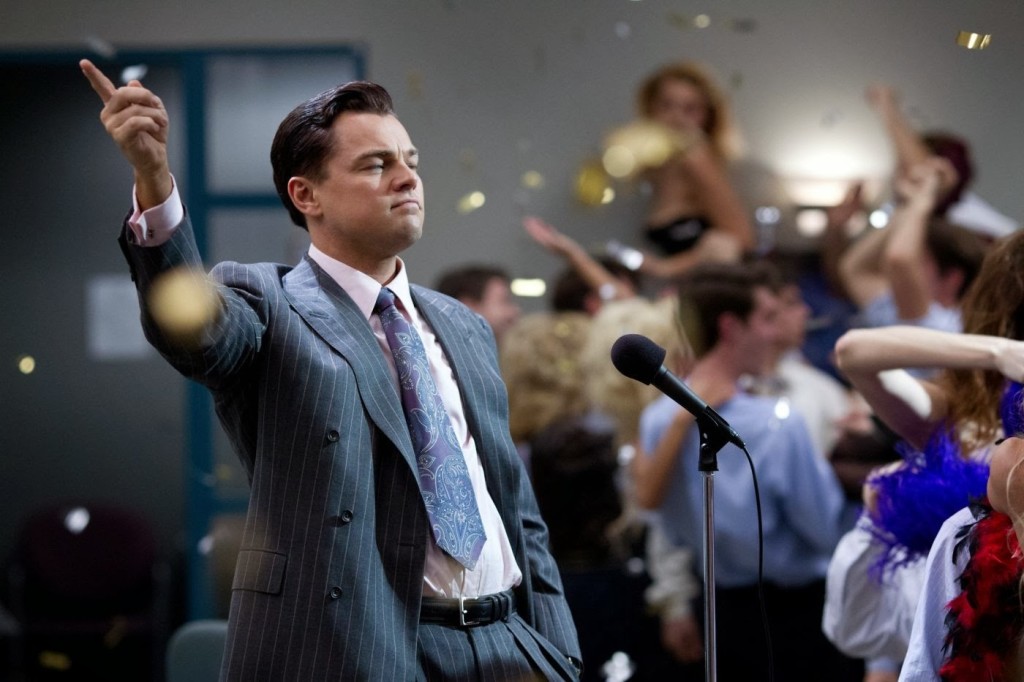
There is an undeniable ick factor at play in Martin Scorsese’s tale of excess for excesses sake, which makes the film feels undeserved in a time when the country is still reeling from a mix of greed and thensome. Watching The Wolf of Wall Street, there is a distinct lack of warmth traded in favor of what Scorsese reads as wit, yet there is no irony to be found here. Satire is meant to instruct, but Wolf teaches nothing and seems eerily comfortable selling you on some misplaced notion that the film condemns where it may seem like it glorifies (rest assured, that strange tingle? That’s its pitch working).
Yet the kinetic youthfulness that drives Wolf of Wall Street towards its three-hour running time feels like its most vital element. Candy-eyed and endless, like commedia dell’arte on steroids, preaching a dangerous gospel that seems like it couldn’t possibly have been crafted by a director in his seventies. Scorsese, whose work has always had a distinct obsession with masculinity at its most brute, and exploitation at its most pulpy, dials everything up, and manages to craft the years most worthy comedy in the process. And while the cries of misogyny are undeniably valid, they do a disservice to Margot Robbie performance as Naomi, whose slow-burn presence truly makes her the manic pixie dream girl of the “greed is good” era. Fittingly, Wolf has little resale value, but perhaps its best to be able to shake the film off easily.
9. Gravity (Alfonso Cuarón; PG-13)
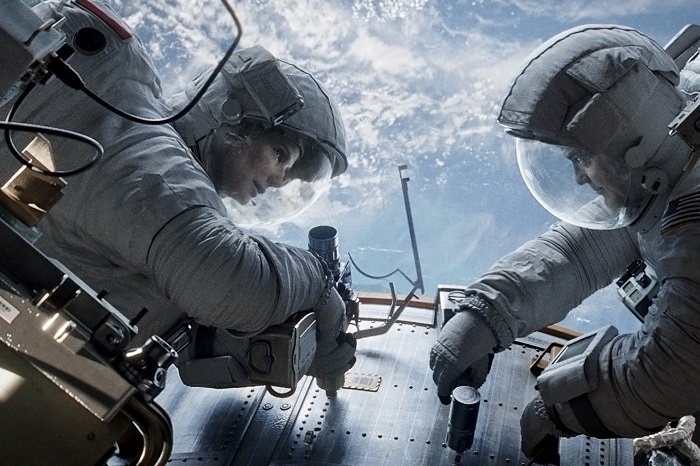
Since 2010, much had been made of Cuarón’s follow-up to Children of Men; From the lead role—rumored at one point or another to have been offered to each and every actress in the upper echelon of Hollywood’s pay-grade—to its oft-spoken opening scene, which was reported to be an unbroken 17-minute shot before even a single second of it was actually filmed. The result is a perfect piece of B-movie schlock that feels like an exercise in both maximalism and restraint. Its reach is simple, and less interested in the philosophical implications of a human lost in as vast and dwarfing a setting as deep space.
While the film’s script (co-written with Cuarón’s son) is often lacking, and the film seems relatively uninterested in letting the silence of space actually simmer thanks to an occasionally overwrought score, Gravity, in its tight 91 minute running time (notable in a year filled with a self-aggrandizing bout of three-hour-plus films) still proves to be a work of pure cinema at its finest.
8. The Act of Killing (Joshua Oppenheimer; NR)

In The Act of Killing, filmmaker Joshua Oppenheimer has been personally invited to North Sumatra by Anwar Congo, one of Indonesia’s most notorious killers, and leader of a 1965-66 genocide that resulted in the death of 2.5 million people. His assignment is largely to recreate the historic massacre in theatrical fashion, dramatizing the horrors in the style of Anwar’s favorite American film genres, in an effort to create a propaganda film that will further the death squad’s already established status.
Most often, documentaries dealing with atrocities of the highest order tend be told from either the perspective of the survivors or the hindsight of the culture. The Act of Killing’s most brilliant subversion is in using the perpetrator as framework. Deceptively charming and disturbingly remorseless, Anwar is a surprisingly captivating screen presence, shown walking down the street, conversing with politicians, and even appearing on talk shows—a celebrity in a military state. When asked about the startling number of people he savagely killed (1,000 by his own hand), and his oft-celebrated method of strangulation (beating them to death had produced too much bloodshed, he explains cheerfully on air), he comes across as an artist speaking about his craft.
All of this, however, is meant to usher us into the film’s climax. The final moments—an almost entirely silent scene of Anwar walking through one of the deaths squad’s former places of execution as he audibly dry heaves for almost a full four minutes—is haunting in the way that it abandons the pretense of shame or despair, and opts instead to throw us headfirst into his disgust. Anwar’s most wretched actions are suddenly internalized, and something akin to regret seems to settle in; we find him as he forgets the camera is running. In deconstructing the principles of documentary, and turning the horrors that Anwar was responsible for into a simulacra of theatrics, the film challenges Susan Sontag’s assertion that the very act of documenting atrocity is to get farther from its truth. Here, the artifice begets the reality, and Act of Killing proves worth enduring, making it a thoroughly challenging, uncompromising, sometimes flawed, but an altogether essential piece of contemporary cinema.
7. No (Pablo Larraín; R)
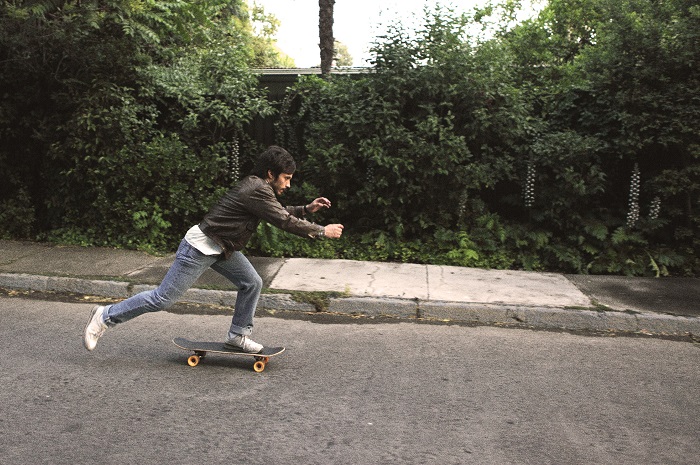
In Pablo Larraín’s Spanish-language No, René Saavedera (Gael García Bernal) is a politically apathetic and in demand advertising executive who looks like Fonzi as part of the 80s ennui of growing cynics. Skating around Chilé in the era of General Augusto Pinochet’s dictatorship, he passes by protests, across parks, and through the day with little engagement and even less at stake. This general apathy evolves as the film does; René is presented with the opportunity to work on the democratic election attempting to overthrow Pinochet after his fifteen-year reign. Much was made about the film’s simplification of the political process, but No is most interested in politics as product than it is in the system itself. Using a commercial sensibility more populist than it is political, René turns the allotted fifteen-minutes of daily airtime into a Warholian mix of high stakes and low-brow.
Filmed on a rebuilt vintage Sony video camera, No’s aesthetic value proves two-fold: it manages to recreate the visual panache (or lack thereof) of the very commercials the film documents the making of, and it also creates a garish disconnect that comes to pass as accepted—an ugliness that fades into the background with similar disinterest as René’s own politics. The inner-implications of the film’s hypocrisy are never explored (using the commercial tyrant that is advertising to bring down the political tyrant that was Pinochet), but Gael García Bernal’s gradually empowered René proves to be the best test case in the film’s cheeky melding of western commercialism and western democracy. And its final moments—with René finding himself again displaced and listless—hint that there is always something elusive in trading one type of control for another.
6. Before Midnight (Richard Linklater; R)

Richard Linklater’s Before Trilogy are, above all else, films about time. The passing of it, the preservation of it, the desire for more of it, and then acceptance that, much like land, there is never more than we were first given. In each chapter of what has become a nearly two-decade-long love story, Jesse (Ethan Hawke, ever boyish) and Céline (Julie Delpy, ever graceful) are given precious few hours with which to better explore one another (though none match the immediacy of Sunset, which tells its story in real-time) before what is largely presented as Real Life resumes.
In Before Midnight, nine years after (spoiler alert) Jesse purposefully misses his flight from Paris, he and Céline are married with two children, settling into middle age with a newfound set of worries regarding time; no longer rife with youthful disregard for its preciousness, but rather anxiety about its inextricable link to mortality, to aging, to spending what little is left with the right person. At times the film lurches away from its witty reputation: a lunchtime talk on the topic of love isn’t nearly as insightful as it thinks it is, and the film lacks a certain urgency that drove the other narratives past lackadaisical and towards something more profound. But whereas the prior films focused on the fluidity of charming conversation, Midnight’s climax is, fittingly, a vicious argument—one that elevates a series once about soul mates into something else entirely, finding something profound in reminding us that these two lovers are not children anymore.
5. American Hustle (David O. Russell; R)
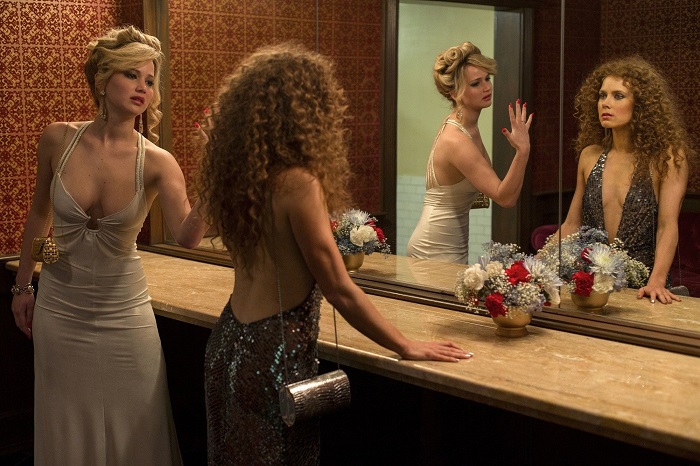
Everyone is on their worst behavior in David O. Russell’s American Hustle, but seemingly with the best of intentions. An actor’s director of the highest order, O. Russell’s new-wave of screwball comedy finds its footing from dialogue more than it does physicality, but Hustle proves that the filmmaker (whose love for Scorsese is in full effect here) has a keen eye for lasting images as well; Christian Bale and Amy Adams’s first kiss at the center of a garment conveyor, with plastic-wrapped suits rotating in a flurry around them, is a particular highlight, and somehow manages to become one of the more lasting pop images of the past five years.
What makes American Hustle most special as a slice of contemporary cinema, however, is that it’s a period piece about people desperate to get out of the times. Caught in the hangover of the post-Vietnam/post-Watergate era, where the American dream seemed in jeopardy, but still accessible if you were willing to fudge the numbers a bit, these characters are desperate nobodies trying to be somebodies in the lingering last days of the party. This isn’t a 70s pre-occupied with disco (though there is disco) or drugs (though there are drugs); it’s a 70s that marks the end of a certain something, and for four lovers of the dream in particular, a potential for new beginnings. Something melancholy hangs in the air, but the audaciousness silences the whimpering, and sells us something else entirely.
4. 12 Years A Slave (Steve McQueen; R)
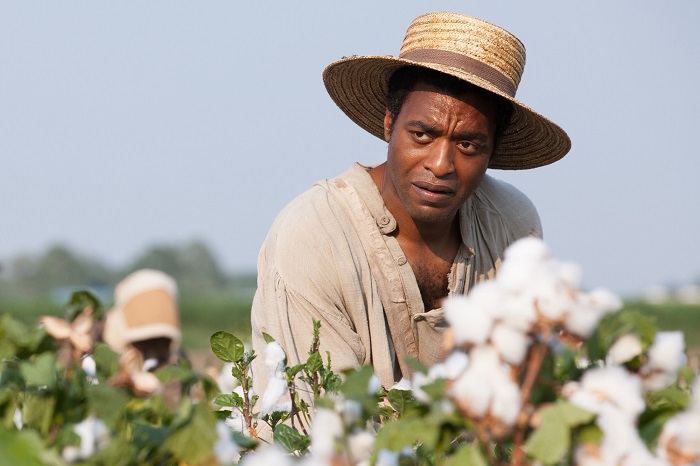
Steve McQueen’s past two films have posited that the human body is at its most organic when seen at its absolute breaking point. When tissue and muscle are extolled through McQueen’s gaze, they take on near mythic levels of meaning, signaling an innate weakness and strength at once. 12 Years A Slave, not surprisingly, continues such fascinations, and in the process manages to become the definitive account of the slave experience.
McQueen, a British born filmmaker, traverses the American heartland, and captures the sun soaked horrors of plantation life at their most mundane, most notably in a scene in which Solomon Northup (Chiwetel Ejiofor), facing punishment, hangs from a tree, his toes scraping the earth below, desperate for any bits of mud to coalesce, all while, in the background, the plantation’s other slaves continue on, the ambient noise from their daily tasks nearly drowning out Solomon’s guttural pleas. In that singular moment, the film’s scope is synthesized. 12 Years is not interested in the theatrics inherit in such material (the film’s narrative accessibility proves to be just as political as it is artistic); what the film desires, and does splendidly, is to negotiate a space in which the slaves at the forefront of the film still seem remarkably abstract—one gets the sense that their general namelessness gets at something more profound than placing them front and center.
You could argue that the case of mistaken identity at the center of the film deflects from the true slave experience, but 12 Years proves to be equally, and most provocatively, about a man coming to terms with his blackness. A haunting close-up of Solomon’s face as he succumbs to singing a slave hymn proves to be one of the most powerful moments captured this year. Here, a once-free man is recognizing more than just his current predicament—he seems to be ridding himself of a certain illusion that proves much more deathly to abandon than any torture inflicted at the hands of another. Somewhere, in loosing himself, he is found.
3. Spring Breakers (Harmone Korine; R)
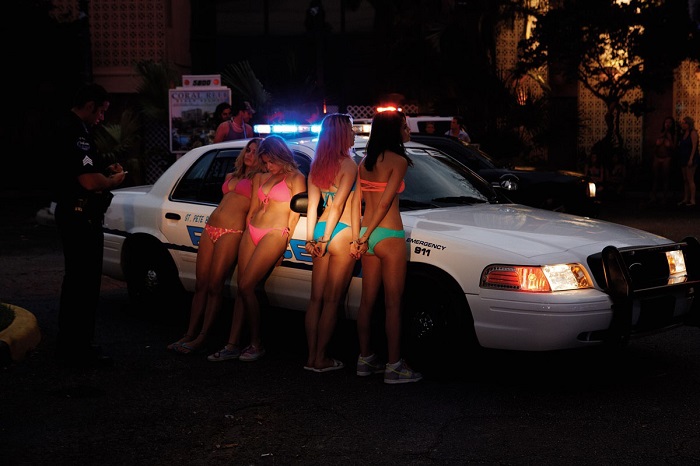
An opening salvo of beer ejaculated and popsicles deep throated interrupts what is initially the familiar soundscape of a quiet beachfront. The youth, the film seems to tell us, have arrived. There is no shortage of bodies bared or money chased, but while many films this year tapped into that same fascination with the American id (Wolf of Wall Street for starters, The Bling Ring as a disappointing appetizer), none did so as euphorically as Spring Breakers. This isn’t the first time Harmony Korine has tackled the American Dream’s transformation into a specific brand of nihilism (2009’s Trash Humpers hovered around similar territory), but there is something more fully realized here, where the tone matches the thesis.
The stunt casting of two former Disney tweens helps round out what is largely a story about good girls gone bad, and there is something powerful in the way the four women assert their sexuality so bombastically and manage to break away from Korine’s unwavering gaze, commanding some semblance of agency in the process. Their bodies often writhing in neon bikinis, they are, nevertheless, fully realized; they tower above James Franco’s Alien, whose character is always performing (for himself just as much as he is for the girls) a type of black masculinity that never feels fully his. So much of Spring Breakers fetishizes youngness (Britney Spears features prominently; squirt guns start off as the weapon of choice), but when the girls force Franco to perform felatio on the tip of a silencer, it feels like you’re watching a paradigm shift take place.
It’s the film’s most hideous moments that prove to be its best; somewhere between a sugar high and a fever dream. The story movies linearly, but the liquid narrative often jumps around in bursts of repetition and haunting echo, and as the story progresses, and our girls thin out in number but multiply their wants, Breakers begins to transform into some sort of hyper-accelerated montage, blending reality and dreamscape in an effort to say that in the current cultural climate, there is little difference between the two.
2. Inside Llewyn Davis (Joel & Ethan Cohen; R)
There is a tendency to consider the musical only on non-diegetic terms, which is largely responsible for its reputation as a niche crowdpleaser. Film like Singing in the Rain and Chicago catapult us into a fantasy world where a full-orchestra hangs on our every word, ready to explore what simple conversation can’t. Far more interesting, however, is something akin to a diegetic musical, in which the presence of music or rehearsal is given context. Films like Saturday Night Fever or, most recently, 2012’s Magic Mike deconstruct any escapism inherit in breaking into song largely by establishing a sense of motivation and development through “performance.” They push the action forward into a realm where that kind of intimacy suddenly has stakes. Whereas the traditional musical is about fantasy, the diegetic musical seems to be about something more soul-crushingly real.
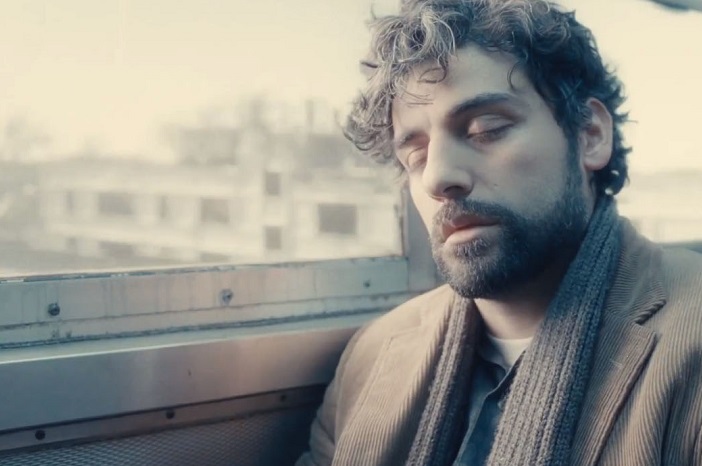
Inside Llewyn Davis is a film largely about loss and loneliness and everything else that seems to infuse all the best folk songs, and its musical numbers serve as both an access point for us and a momentary reprieve for Ilewyn himself (played by Oscar Isaac, whose prickly vulnerability make him perhaps the Cohen character most deserving of misfortune). When Illewyn is strumming on his guitar, always in intimate close-up and through a filter that looks like Dylan’s “Freeweelin” album artwork dipped in cold water, we see both high and low in equal measure. Some wall is coming down, and for a moment we get a peak at the man just getting used to singing alone.
The narrative momentum may strike, initially, as strangely meandering, especially when a sudden trip to Chicago proves to be the film’s invisible crux, but its quiet is meant to sustain us. There is no rose-tinted nostalgia here for Greenwich in the winter. In the final fleeting days before the folk music scene became a crowded place, there were only lonely men walking in the snow, coming to terms with being good but not great.
1. Frances Ha (Noah Baumbach)

Like Inside Llewyn Davis, Noah Baumbach’s Frances Ha is similarly about the chaos and malaise that follows the breaking of an intimate partnership. In lush black and white and nearly wordless montage, the film opens with Frances (Greta Gerwig) and her best friend Sophie (Mickey Sumner) on what we take to be just another in their series of perfect days, play fighting in the park, busking outside the subway, smoking on their fire escape and finally sleeping in the same bed. There are few terms more overused than “a star-making turn by Greta Gerwig,” but in Frances Ha, Gerwig has truly crafted just that. Her every movement—they way she lurches forward when speaking, and then begins to retreat into herself at the precise moment her stories begin to sound like they should stay inner-monologue—is precise; she breaks our heart with every wide-eyed stare.
As the Parker Posey of the early-2000s mumblecore movement, Gerwig is no stranger to stories about stunted adolescents and general meandering; but she is careful here, avoiding the trappings of the material’s relevance. So much has been made of this generation’s stagnation—a creative class with seemingly very little creativity to offer, or energy to offer it with. In Frances Ha, characters are recognizable in their verisimilitude. Frances’s oft-quoted defense against questions regarding her direction—“I’m young, I’m only 27”—feels very of-the-moment, and could, in less confident hands, make Frances seem like a big sister to Lena Dunham’s Aura in Tiny Furniture.
Yet what Frances Ha illustrates so poignantly is the extent to which we hide less in ourselves, and more in one another; how growth is delayed largely because one looses any sense of urgency when they find their other half. That delay is less the result of fear or a stubborn refusal to acknowledge responsibility, but is, for Frances, rather the desire to embrace something as fleeting as joy for just a bit longer.
The joy of partnership, in fact, is found everywhere in the film. This marks Baumbach and Gerwig’s second collaboration, and his first film since 2010’s Greenberg. In that film, Ben Stiller plays a similarly untethered and unfocused man-child, and there are ways in which that character could be read as an insight into who Baumbach was in that moment in time, as his marriage to actress Jennifer Jason Leigh (who also starred in the film) began to fizzle. Frances Ha, however, reads like a love letter to Gerwig (who co-wrote the script with Baumbach), and marks a decidedly different way of looking at the world through the same framework. She seems to have worked magic on Baumbach; by the film’s end, we know the feeling.