


By: Nancy Lippincott Category: MUSIC Date: 2.May.2014
Girl On Top: Janet Weiss
Janet Weiss in conversation: We talk to the legendary Quasi and Sleater-Kinney drummer.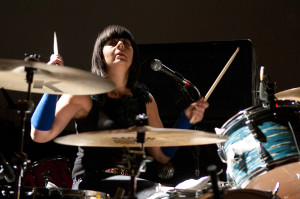
When Janet Weiss was in her early twenties, she picked up a drum pad, and for the first time started playing for fun. No lessons, no experience. But it’s something she wanted to do. Eventually she honed her skills and garnered the recognition as one of the greatest indie rock drummers of our generation… not to mention a veritable icon of D.I.Y counterculture.
Weiss has been involved with many great projects over the years-—Sleater-Kinney, Stephen Malkmus, The Jicks-But one venture that has stuck throughout it all was Quasi, a passion project with once ex-husband but longtime musical collaborator, Sam Coomes. Quasi has lasted for more than twenty years, and now, Mole City is their ninth complete album and first double LP. We got to pick her brain about the new album.
Congratulations on the release of Mole City! It’s arguably your magnum opus to this date.
I hope so! We always wanted to make a double record, but we didn’t want to make it unless we had enough material. We hunkered down and worked and played music and hung out. Started planning, kind of reassessed, added a few things we thought the record needed, and then, you know, finally it’s the release date and it’s real.
There’s a track titled “Nostalgia Kills”-when I listened to the whole album, I felt like I was going through a nostalgic musical journey. On one hand you have songs like “R.I.P.” with a bluesy, old-timey feel. By the time I got to the end of the album with “New Western Way” which made me think of Pink Floyd—like an homage to the evolution of music. Was this intentional?
I think yes in that it’s definitely meant to be a journey. We decided how to put it all together. We definitely wanted the end
to have a certain feeling. I think you’re sort of sensing how Sam has themes that have remained throughout his writing,
definitely nostalgia. He talks about nowhere a lot and death and disappearing and ghosts and just sort of finding a place in the world. And I think that’s explored even more on this album. You’re definitely hitting on really a major thing with him. And a lot of what you’re hearing are sounds that we love like Pink Floyd. I picture him as a teenager… that teenager, it never gets out, it’s always in you.
You came up during a time of DIY, technologically things weren’t developed nearly at the level as they are today-your first album was recorded on tape. How have things changed for you?
The funny thing is that this record is not so far off from that. We have learned a lot over the years and it’s still bare bones—no money, the two of us in a little room. It’s still very, very DIY. We just happen to know a little bit more. But I think ultimately we like it like that; those are our roots. We’re not comfortable in a fancy studio. It’s not about pristine sound for us, although we have tried in the past. There was definitely a period when we were caught up in compressors, kick
drum sounds, and microphones…but it’s not about the fancy studio. It’s about the meaning and the connection between us
and what we make together. But now the way the listener interacts with a band is different I’s mostly on the computer.
Now most music makes its way to people via the digital world. What is your take on this new state of recording and distribution?
Things have definitely changed. In our eyes it’s a lot harder now. It used to be that a band would go on tour you were
so excited because we had to wait. They might have had the record or read an interview, but they waited for you to come
to town. Whereas now, that excitement and anticipation is gone. What do you do about that? How do you create excitement over and over again repeatedly?
Has all this changed your experience as a listener of music?
Definitely. I mean, Sam would say no, but I would say yes just in that there’s just more marketed, there’s more coming at
me. I’m definitely not giving things as much of a chance as I used to. I probably check out the same amount of new music…
but I’m not seeing them and getting the experience.
Like meeting a guy in person versus meeting him on OK Cupid?
Totally! If you’re going to a show you’re really giving someone a chance. You’re investing time and you’re actually leaving
your house. But you’re also putting yourself in the position where they can win you over. You can have a real experience.
You can be moved by it, you can be changed by it. But on the computer it’s really hard to do that. Buying records to
check out bands just doesn’t happen anymore. I dunno, I feel like there’s a real wave of commercialism in music that I’m
sort of repulsed by, there’s a lot of bands that want to be on commercials and think that it’s a viable way of being artistic. I’m not interested in that.
Do you think that temptation exists because musicians aren’t selling actual albums like in the past?
I don’t care! To just give in like that and say, “Oh boo hoo, we’re not making any money off of albums.” No one ever made
money on albums anyway! People made a little money but no one got rich off their records. So now it’s not even frowned
upon to sell your credibility or your art, basically.
Well you frown upon it!
It’s something I rant about quite often. You wonder why no one will pay for your songs, you don’t even value your songs
enough to keep them out of a diaper commercial. What is that telling your listeners? It’s telling them you don’t give a shit, in my eyes. We’re not like Beyonce. We’re not making choices based on what will sell records. We’re making choices to stand for something and express ourselves and what we believe in. This is where I came from—punk rock and everything that followed after that. Speaking out, being rebellious, being angry, and letting that all fly. It’s not about commercialism and selling some big corporation’s product.
Now that the album is complete, do you feel creatively tapped? Or do you still get inspired?
Not really! It’s fuel for the fire. We’re having success at it. Things will go rough because we’re exhausted, but then things
start going well. I’ll launch right back into another project. I’d rather not sit around. I’d rather play.